We Don't Have to Reinvent Slavery With LLMs
There's a trend that I first picked up on about two years ago that has grown more and more prominent in the tech world: that of talking about AI using slavery terminology. This is somewhat surprising to me, given the fact that the vast majority of folks in the tech world lean very far leftward, as opposed to the alt-right types who might be inclined to say things like, "Some slave masters treated their slaves very well...." So why is it socially acceptable to talk about AI like we're enslavers?
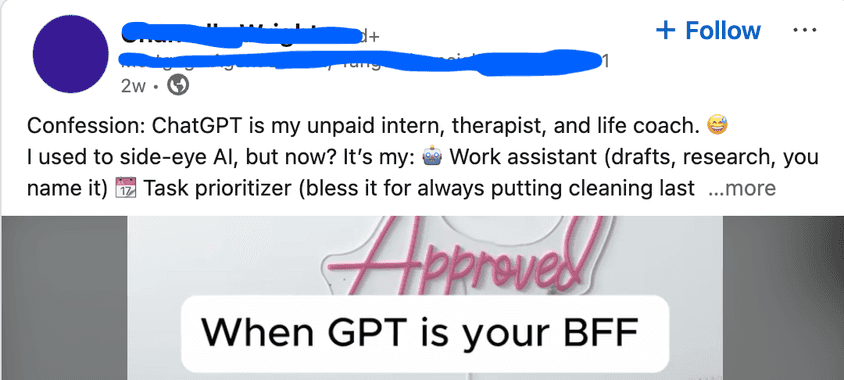
First, it would be helpful to give you some examples of what I mean. When ChatGPT took off at the end of 2022, I read a post on LinkedIn from a designer I follow who enthusiastically talked about the ways in which ChatGPT functioned as his own personal "unpaid intern." This framing struck an off note for me, because required labor without compensation is... slavery. I thought that maybe it was just a one-off, poorly considered post. An anecdote. But since then, it's become a trend to treat machine learning models as persons, and to treat them specifically as persons who do free1 labor for you. Search LinkedIn for "chatgpt unpaid intern" and you'll see posts like this:
A few weeks ago, someone sent me a link to Taskmaster AI, a "project manager" for all the AI agents that are writing code for you. The name Taskmaster is likely intended to be a witty pun; the work of writing code is an endless list of tasks to accomplish, and it would undoubtedly be handy to have an app that keeps track of those tasks for you. However, the word "taskmaster" actually means something, which is, "A person who imposes a harsh or onerous workload on someone." Historically, a taskmaster was specifically the person whose job it was to whip slaves into working harder and to punish them when they slacked off.
Last week, a company called Luminary launched a product on ProductHunt called Solar 4, described as "an infinite canvas for vibe-coded production apps." As I scrolled through their pitch slides on ProductHunt, I noticed the last slide describes their product as, "Your personal engineer who never takes lunch." Now, the notion of a smart, intelligent engineer who does work for you for free and never takes breaks sounds... amazing, right? Imagine the productivity gains! But stop and think for a second. The only reason this sounds "amazing" instead of "flying in the face of labor laws, common decency, and human rights" is because we all know we're not talking about a human.
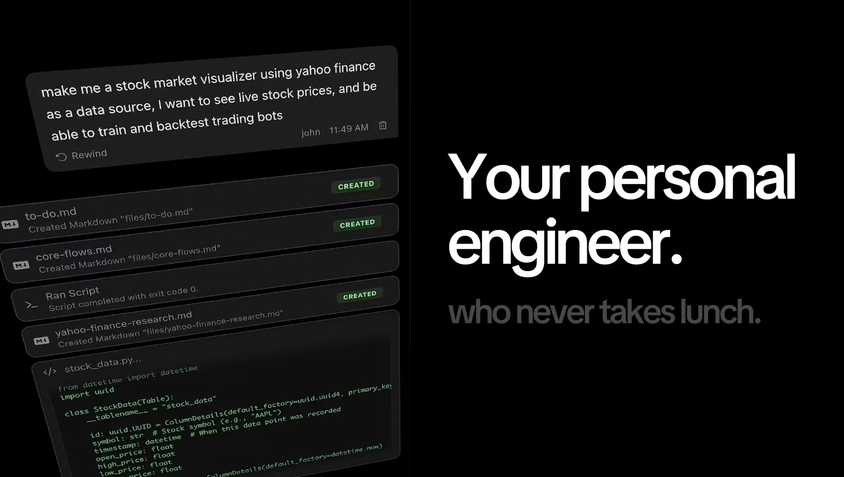
Image credit: Luminary, Inc.
The inhumanity of the worker was precisely the key insight that made chattel slavery plausible in the United States. Consider the dilemma, for a second: there was so much cotton to be picked in so little time, and to have to pay all the workers required to do the job would quickly make it far less realistic from an economic standpoint. Agricultural margins are and always have been pretty slim. At the same time, there's something within us that deeply rebels at the notion of enslaving people who are just like you and I—it feels wrong. So the next logical step was to figure out an ethical sleight of hand whereby you could declare your workers subhuman, and voila! Now there's no ethical dilemma. They're not human like you and me, see, and they were made to work in the hot sun for no pay. So really I'm just doing the Lord's work here.
An ironic reversal
Whereas with chattel slavery we started with humans and stripped them of their humanity so that we could justify exploiting them to do work that was "beneath" us, with AI we're starting from the opposite place of creating something that is genuinely not human and humanizing it to feel like a worker... and then treating it terribly. This is ethically horrible in a whole new way, precisely because it is so utterly unnecessary. We don't have to reinvent slavery. We don't have to humanize machine learning models, and yet we're doing it anyway.2 By God, how callous are our souls?
When I say that it doesn't have to be this way, I mean that there was no specific reason that required us to treat language models as intelligent persons. It was simply a choice, a marketing choice, to call these models "artificial intelligences." It sounds super cool and amazing, and yet the fact of the matter is that it is nothing more than a marketing gimmick, at least at first. "Skill" is the ability to do a task effectively, whereas "Intelligence" is the ability to pick up such a skill quickly and without a lot of hand-holding. Some ML models are undeniably skillful with certain tasks, and yet they are also the opposite of intelligent: it takes them millions of tries to learn those tasks correctly. To be very blunt, if it took you a million games of chess to learn how to play it well, I would not think you very intelligent.
But what are we to make of the evident utility of apps like ChatGPT, Claude, Gemini, etc.? Some of what these various language models and frontier models can do is genuinely astounding, and at this point you might feel like I've put you in an ethical bind where it would be crazy not to use them in your day-to-day job, but you're also sitting in the seat of the enslaver if you do.
Isn't this all a little dramatic?
I've shared this point with a number of folks recently, and the most common response I get is that it seems like an overreaction. Is comparing AI to slavery just a new sub-branch of Godwin's Law?3 I'm sympathetic to this point, actually. Back in 2020 as part of the reckoning with racial injustice, the software industry invested a lot of its energy into thinking about the words we use. The vast majority of software projects used the name "master" to describe the primary, clean version of the software, and when tech folks realized the connotations this had with slavery there was a movement toward calling that primary copy "main" instead. Other folks insisted that we move away from "blacklists" and "whitelists" toward "deny lists" and "allow lists."
Whether that grand-scale renaming project was "right" or not is one thing, but it's another thing to note that it was mostly performative. That is to say, only about 7% of the U.S. tech industry is made up of Black people, and the 2020 reckoning didn't really change that statistic. The language policing (I say that descriptively rather than derisively) didn't result in a more equitable allocation of tech jobs back then. Is my angst about AI and slavery largely the same kind of thing?
Let's carefully think about what Godwin's Law does and does not mean, though. His observation was simply that as conversations grow more heated, the temptation grows to resort to ever more extreme comparisons. Godwin's Law does not imply that every comparison to Hitler is therefore unwarranted. My consternation with how we talk about LLMs does not come from a desire to virtue signal or to sound holier than thou. It comes from a belief that the way we use language shapes our behavior in real and meaningful ways.
If I refer to women as "b**ches," "h*es," or "helpmeets," I'm much more likely to think of women in an objectified manner than if I say "women." If I talk about my job as "the 9-5 grind" I train myself to think about it in a different way than if I talk about it as "my vocation." If a sitting U.S. senator views their position as a "platform" with which they can "own" their political opponents, they're going to engage in the day-to-day particulars in a vastly different way than the one who views their position as a sacred duty to honor their constituents by persuasively advocating for them.
So too with LLMs. If I'm training myself to think about LLMs as unpaid interns, workers who never take lunch breaks, cheap/free replacements for my coworkers, etc., then I'm doing grave damage to myself. Now, whether you think my comparison between LLMs and slavery holds any merit or not is up for you to decide. I'm not even suggesting that we shouldn't use LLMs, just that there are far better ways for us to approach their use than are currently in vogue—and those better ways don't even really require that much of us.
What we can do
Simply put, I think we can start calling these things what they are rather than LARPing like we're in some futuristic sci-fi movie. When I prompt ChatGPT with a string of text, I'm prodding the model to run in a certain way that is hopefully useful toward my ends. There's nothing in that action that necessitates me thinking of ChatGPT as an "unpaid intern." If I use Cursor or Zencoder to generate code in response to a prompt, there's nothing in that action that requires me to think of it as an "engineer who never takes lunch breaks." I very easily can interact with LLMs in a manner quite similar to the way that the vast majority of the world has interacted with a traditional search engine over the past couple decades: as a tool that does a job.
We would enter our queries in the Google search box and it would return results. I didn't refer to that search box using personal pronouns, because Google (unlike Ask Jeeves) decided not to present it as if it were a butler doing my bidding. I never referred to spellcheck in Microsoft Word as my "unpaid copy editor" because nobody chose to use that metaphor. It did the job without requiring me to imagine myself into an ethically compromising position.
If I'm a product manager shipping a new LLM-powered feature in my app, I don't have to ship it using personal language. I don't have to call it an "agent." I don't have to call it an "AI assistant." If I still want to play up the magic and the sparkles, I could in fact do that while still being honest about what it actually is. It's a machine learning model that's quite useful for a particular task. If I'm an engineer who is asked with implementing such a feature or a marketer who is tasked with writing copy for it, I have the agency to push back and suggest something better.
If I'm a CIO who feels the pressure to get my company on the AI hype train, I could choose to send my company's dollars toward ethical products instead of something that might be flashier but more ethically dubious. For that matter, if I'm an individual contemplating using LLMs in my own personal life, I could use models like Claude, Mistral, or even Gemma instead of ChatGPT or Llama, and I could choose to phrase my prompts like I'm querying a search engine instead of bossing around a person who has no rights.
Though it probably sounds like I'm some luddite who is entirely against everything that this new technological wave represents, that is not the case. I use LLM-powered search engines almost exclusively now. I use tools like Cursor and Glean at work. My only plea here is that we give a moment's thought to the ethical ramifications of LLMs. Specifically:
Practical suggestions
Ethical training. Let's train them using ethically sourced data. Yes, it's possible. It may not give us models that perform quite as well, but "it works better" doesn't make theft okay.
Amplifying the goodness of human work. Let's deploy them in ways that amplify the effectiveness of human labor rather than in a capitalistic mindset of replacing human labor with crappier, machine-driven versions.
Better metaphors. Let's get away from choosing to refer to LLMs using personal pronouns and treating them as if they're our "unpaid interns" AKA slaves. For the decision-makers shipping LLMs as products, let's frame them as tools that you can use instead of as persons that you can exploit.
Or watch this video from The Onion lampooning in fewer words what I'm trying to say in earnest with this post 😅
- The notion that LLMs are "free" is another misconception; the fact that they're underwritten by vast amounts of venture capital right now makes them feel free, but they are not. It's like the early days of Gmail when we all had "infinite" storage for our emails.↩
- The core issue of thinking about work that is "beneath" us and that therefore should be automated/outsourced remains. Consider Wendell Berry's essay, “Economy and Pleasure,” for the problems with this way of thinking. The notion that certain work is drudgery that should be automated is, however, critically different than thinking certain work would be better done with a sharp tool rather than a dull one.↩
- Godwin's Law states that as an online discussion grows longer, the probability of a comparison involving Nazis or Hitler approaches one.↩