Reading Recap 2025, Part 1: How and Why I Read 200+ Books
I wrote a post very similar to this about a year ago, and I wanted to revist the topic again this year to try to answer some of the questions I got after that last post.
Ten years ago, I set myself the ambitious goal of reading 100 books in a single year. I did not achieve that goal—not even close. I read 60 books in 2015, and then the following year we had another child and my reading dropped down to 31 books, and I wouldn't get anywhere close to 100 books in a year until 2020 when I read 84. And that felt like a ton. The following year my total # of books dropped down again to 51, even though my page count was almost as high (meaning the books I read in 2021 were much longer on average). But then something interesting happened from 2021 through this year, as you can see in this chart:
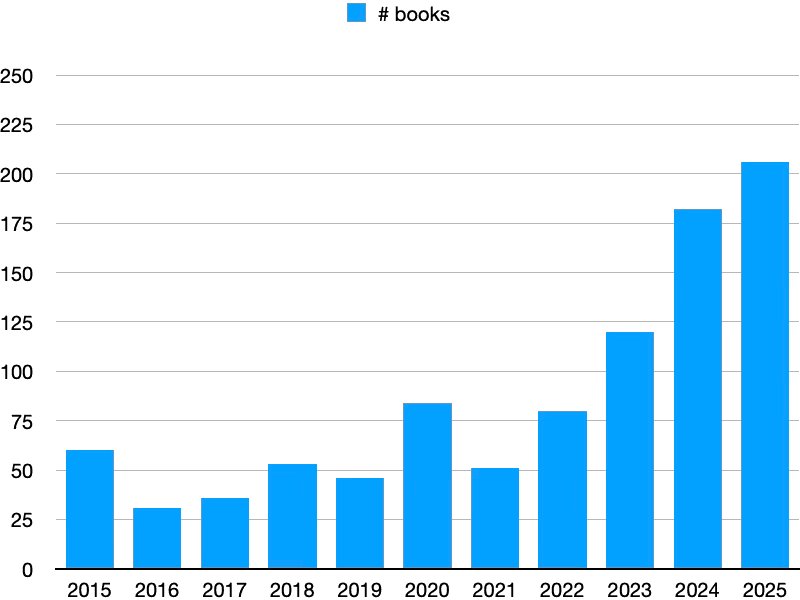
Over the past 5 years, my books per year has steadily increased by leaps and bounds. In 2023 I finally achieved my goal of 100 books per year that I had set in 2015. But it kept growing from there, and this year I hit that goal by June and kept going, achieving more than 200 books total.
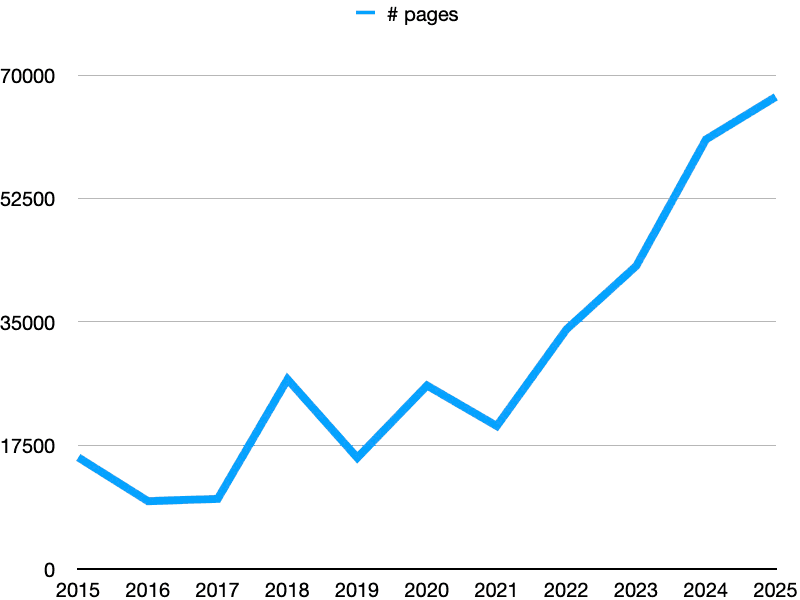
Now, there's a pretty obvious way to game this metric. You could read 200 children's books and probably get it done in a day or two. This is one of the main reasons that I hear from fellow readers that book count is not a very interesting metric. So here's my page count per year metrics as well. You can see that it mostly correlates to book count:
So what?
For many, the whole notion of keeping metrics on what you read is antithetical to their entire purpose of reading. The whole point of reading, they'd say, is to get away from modernity's obsession with speed and quantification and comparison. If that's you, this post probably comes across as so much braggadocio. The reason I track what and how much I read isn't about bragging rights, though. Instead, it comes from one very simple observation: by measuring how many books I read, I'll gain insight into my reading habits and be able to increase my reading speed.
Why would I want to do that? Between 500K-1M books are published each year in the US alone. Let's take the conservative estimate, and say that it's merely 500K and that 99.99% of them are garbage that are not worth reading. That means that there are 50 books published in 2025 that are worth reading. That's the conservative estimate. To that, add up the top books that have been published every single year in the past—the ones I haven't read yet. Not all books, just the very best that I know I want to read before I die. Even if I select only the crème de la crème, the top 10 books from each year from only the past century (disregarding all of human history before that), the stack on my nightstand is now roughly the height of a 10-15 story building.
Let's add some more complicating factors:
- My interests range far wider than just the "best of" books from each year. I read plenty of books not because they're particularly great, but because they have information I need. Other times I read books simply because they're pulpy and fun, or because a friend recommends one.
- I read and review books for publishers.
- I'm always discovering new books to add to my to-read stack that might not be particularly noteworthy to anyone else, but that I want to read for one reason or another.
- Sometimes I read a "must read" book and discover that I absolutely hate it, and I resent that I spent any time on it at all.1
- I like re-reading books: coming back to the ones that left an impression on me.
When I add re-reads, pulps, research books, et al. to my stack, it gets even higher. We're now talking about a literal skyscraper of books to read, and it's one that keeps growing taller every single year. If I could somehow know ahead of time that the "must read" that everyone loves is going to be a dud for me, I would be able to subtract those books from my list and make it a little more mangeable—but I can't know that ahead of time. Instead, I can get better at speed reading books so that the time cost of reading a new book is much cheaper. If I can read each book 2-3x as fast, my skyscraper of books is suddenly 2-3x shorter. The net result is that if it's a relatively negligible cost to read a new book, then I suddenly have a lot more time for re-reads.
If I allow myself to re-read a book, that frees me from the pressure to have 100% reading comprehension on the first pass. If I can gain an overall impression of a book in a couple hours, then I can know whether a) I should jettison it early and add it to my DNF list, b) flag it as a re-read that I can come back to at a slower pace, or c) finish it but not feel the compulsion to have to return to it.
All that said, the reason I track how many books/pages I'm reading is so that I can get better at reading in the same way that an athlete keeps metrics on how fast they can run a mile, how much they can bench, etc. It's not about bragging rights, it's about attentiveness to the discipline.
Tackling the tower
Even if I reduce my skyscraper of books by 2-3x, that's still a ton of books. I need to not only figure out how to read new books faster, I also need to figure out how to have more raw time to read. I have a full time job, I'm married, I have 3 kids, I like to spend time with friends, I like to watch movies and TV shows sometimes, I have to go grocery shopping and take care of elderly parents, I like to spend time keeping up with the news, etc. You get the picture. I invest zero minutes of my life into watching sports. I do not have Instagram or TikTok. I play video games only rarely. Even so, when do I have the chance to sit down in an armchair with a cup of coffee and a paperback? The answer, for me, is "rarely."
That's why it's been very important for me to lean into alternate modalities of "reading." I know that it's controversial whether listening to an audiobook "counts" as reading, but honestly, I don't really care whether it "counts" for someone else. For me, audiobooks make reading accessible again because I don't have the luxury at this stage of life to sit by the fire with a book, as much as I would love that. Audiobooks fit into the nooks and crannies of my life: when I'm walking the dog, when I'm running errands, when I'm washing dishes, when I'm changing the oil on my car, etc.
I'll get even more controversial now. Not every book has an audiobook edition, and in fact a huge majority of the more technical and/or academic books I care about do not. My iPhone, however, has an accessibility setting to read ebooks aloud using Siri, and so I use that quite a bit. It's not particularly pleasant, but I don't read those kinds of books looking for a pleasant experience anyway. I read them for information and argumentation. Siri is good enough for that purpose.
I manage to cram even more books into my life by orienting my family's life around books as well. One of my favorite reads this year, The Call of the Wild, was a family readaloud. I orient friend time around books as well by doing things like reading books with a book club. I reclaim my sleepless hours in the middle of the night by putting on an audiobook and setting the timer to turn off after a half hour.
Another benefit of being attentive to my reading metrics is that I notice when I hit a reading slowdown. Everyone's heard of Writer's Block, where you can't seem to get one more word down on paper for whatever reason, but the inverse also exists: Reader's Block, where your brain has maxed out its threshold of new words it can ingest. This was precisely the reason why I had trouble hitting 100 books per year for such a long time. I would hit Reader's Block and I just couldn't force myself to read another word.
My solution to Reader's Block is variety. When I look back at 2015, the year I tried and failed to hit 100 books, a full 75% of the books I tried to read fell into the overall genre of "Christian books." Of those, the vast majority were even from the same general theological point of view because I still believed that it was important to choose Christian reading based on what I (probably) already agreed with. The point here is not to evaluate that line of thinking, but to notice one effect it has: namely, that my brain has a maximum capacity for so much of the same thing.
There's an interesting corollary here to computer science, where it's long been known that if you have three tasks and you can process only one of them at a time, that's going to take longer than if you can process all of them in parallel. Even when you can't execute tasks literally at the same time, you can still do them concurrently by starting multiple tasks at the same time and switching between them when you have good opportunity to do so. The danger of concurrency, though, is that it can get messy. Reading multiple Christian books at the same concurrently had the effect that they started to bleed together in my brain. I could avoid this by reading only one at a time, but that defeated the purpose of efficiency. Concurrency is much easier to sustain, though, when there's clear delineation between the threads I have open in my brain. So rather than reading 5 theological books at a time, if I'm reading 1 theological book, 1 sci-fi, 1 historical work, 1 memoir, and 1 about current events, it's a lot easier to keep them all separate in my head. Concurrency is how I get around Reader's Block, and specifically, carefully chosen concurrency.
The last piece that is important for tackling your tower is money. There's no doubt about it that books are expensive, and so finances can obviously also become a limiting factor to how much one reads. I have a fixed amount of money that I can reasonably spend on books per month, and if I were to pay full price for each book I read, there's no way I'd be reading 200+ books per year. So here are a few hacks to bypass that as a limitation.
- Public libraries. I'm blessed to live in a country, state, and city where I have access to an embarrassing number of high quality public libraries. Not every country is like this, and even in the US, not every geographic area is like this. If you have access to even one library, use it. If your library offers services like Libby, you can check out ebooks and audiobooks without even having to physically go to the library. I am a heavy user of Libby, and one Libby-specific hack is that you can use their "deep search" feature to look for books that your library doesn't currently have access to and then click "Notify me" and it'll let your library know that you want them to acquire a title. If you have access to multiple local libraries in your area, you can get library cards for all of them and add them to Libby and you'll get access to all their combined catalogs in one app.
- Little Free Libraries. If your neighborhood has one, you could check it to see if there are any gems, and you can pass along the books you've enjoyed that you're probably not going to read. One phenomenon I've noticed, though, is that people often use them in bad ways by taking good books and passing along crappy ones. Please do not do this. It turns the Little Free Library into basically a book trashcan. If your neighborhood doesn't have one, build one!
- Services. Most folks know about Audible, but there are other ways to purchase audiobooks that don't actively support an awful company. Libro.fm is one of my favorites; it's a lot like Audible, but you select a local bookstore and a portion of the proceeds from your purchases go to supporting that bookstore. I've selected Black & Read as my local store. If you have a Spotify Premium subscription, you get access to 15 hours of free audiobook streaming with your plan, which is enough for a decent length book.2 I can't imagine this will last forever given that a) it's basically giving away for free what Audible charges for, and b) the Law of Internet Enshittification means that this will definitely get independently monetized eventually.
- Sales. Put together a list of books that you want to purchase and then wait patiently for your favorite book store or online book service to have a sale.
- Thrift stores. I've found a number of amazing books at local thrift stores. Other than getting them for free at libraries this is probably the cheapest way to acquire books, but your selection is limited by the happenstance of what people have donated.
Why, though?
I'm a highly intellectually curious person. There's a lot of things I want to know about and understand, and there are still other things that I already know about but want to think more deeply upon. I read about as many genres per year as the average American reads in total books per year, and again I say that not as a brag but simply as an answer to "Why are you trying so hard to optimize your reading efficiency?" In part 2 of this article I'll go through the actual books that made an impression upon me, but here I'll just share the specific genres that interested me this year:
- Theology, biblical interpretation, and ethics
- Memoirs/biographies
- Writers on writing
- Human origins
- Classics/recommendations
- Sci-fi & fantasy
- Current events
- History & historical fiction
- The natural world
- Work/self-improvement
I dabbled in a book or two from a few other genres this year as well, but these were the main ones. If I have a driving interest in that many different kinds of books, I have to treat reading as a discipline that I hone rather than just a hobby I engage in for the cozy vibes. There's no shade thrown at people for whom that's all that it is (genuinely!), but for me it's a key piece of my intellectual and spiritual life, so I treat it with a high degree of rigor. In the next article, I'll share my top reads from each of those categories.
- One of these was Jonathan Strange & Mr. Norrell this year. It's a highly rated book that was even turned into a TV show. People rave about it. I thought it was interminably long, tedious, and had very little payoff for the 1000+ pages that it was. No shade thrown at the author, but it was clearly not my cup of tea.↩
- Spotify is also not a particularly great company. Still, the tip is here since so many people have Spotify Premium subscriptions.↩